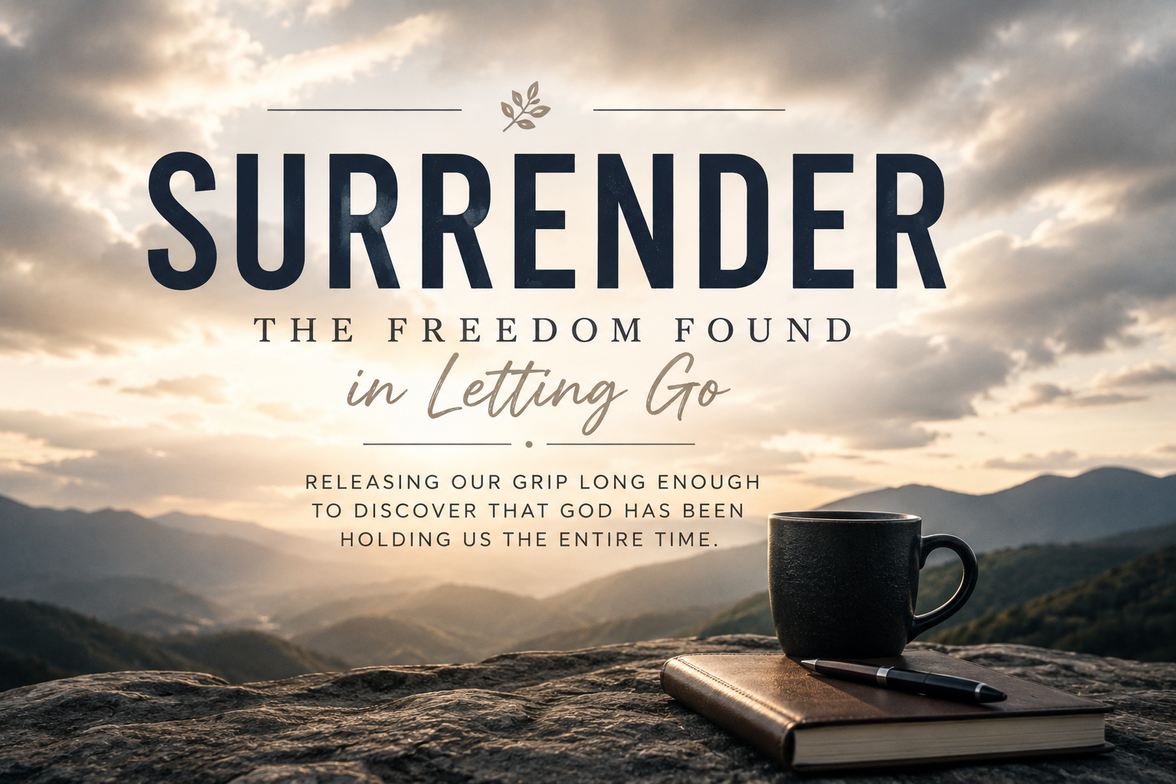
Surrender

There is a tension many of us wrestle with silently: the desire to trust God fully while still trying to manage every outcome ourselves.
Control has a way of disguising itself as wisdom, responsibility, or preparation. We convince ourselves that if we think harder, plan better, monitor more, or hold tighter, we can somehow secure peace. But often what we call “management” is really fear searching for certainty.
The truth is, control gives the illusion of safety while quietly exhausting the soul.
Scripture reminds us in Proverbs 16:9 that “A man’s heart plans his way, but the Lord directs his steps.” We can make plans, but we were never meant to be sovereign over our lives. James 4 further humbles us by reminding us not to boast about tomorrow because we do not truly know what a day will bring. There is a difference between stewardship and trying to play God.
Surrender begins when we stop confusing control with trust.
Surrender Is Not a One-Time Event
Many people think surrender is a dramatic altar moment, a single prayer, or an emotional experience. While those moments can be powerful, true surrender is much deeper than a moment.
Surrender is daily.
It is active, present, and repeated.
Luke 9:23 says, “If anyone desires to come after Me, let him deny himself, and take up his cross daily, and follow Me.”
Daily means surrender must be revisited continually. Some days surrender looks like obedience. Other days it looks like silence, restraint, humility, forgiveness, or trusting God when nothing makes sense. Sometimes surrender is simply waking up and choosing again to believe God despite disappointment, uncertainty, or delay.
It is not passive weakness. It is intentional yielding.
Asking for Help Requires Vulnerability
One of the hardest forms of surrender is admitting we need help.
We live in a culture that praises independence so strongly that many people suffer in silence rather than risk appearing weak. But God never designed us to carry life alone.
We are wired for connection.
Galatians 6:2 tells us to “bear one another’s burdens.” That means some weights were never intended to be carried by one person alone. Isolation often deepens pain, while healthy community helps restore strength.
Proverbs 11:14 says there is safety and victory in the multitude of counselors. There is wisdom in allowing trusted voices to walk alongside us. Surrender sometimes looks like opening your mouth, telling the truth, and allowing others to support you where you are struggling.
Vulnerability is uncomfortable because it exposes our humanity. Yet often healing begins where pretending ends.
Releasing the Outcome
One of the deepest levels of surrender is not just releasing control, but releasing the outcome.
Many of us say we trust God, but internally we still expect Him to respond the way we prefer. We pray with predetermined conclusions. We trust Him as long as His answer matches our expectations.
But surrender means trusting God even when His response differs from what we hoped for.
In 2 Corinthians 12, Paul pleaded with God three times to remove the difficulty he was facing. God’s response was not removal, but grace: “My grace is sufficient for you.”
Sometimes God says yes.
Sometimes He says wait.
Sometimes He says no.
And all three responses still require trust.
Isaiah 55 reminds us that His thoughts and ways are higher than ours. There are things God sees that we cannot. There are purposes beyond our understanding. Surrender means accepting that God’s wisdom is not limited to our perspective.
Trusting God means trusting His will over our own.
Releasing Control Produces Genuine Freedom
Ironically, what many people call control is actually bondage.
Trying to manage every detail, every possibility, every person, and every outcome creates a constant state of pressure. Anxiety grows when we attempt to hold responsibilities that were never ours to carry.
Surrender feels frightening at first because it feels like loss. But what we actually lose is the burden of carrying something too heavy for us.
John 8:36 says, “Therefore if the Son makes you free, you shall be free indeed.”
Freedom is not found in controlling everything around us. Freedom is found in trusting the One who holds all things together.
Galatians 5:1 tells us to stand firm in that freedom. This means we do not return to the bondage of fear, striving, overthinking, and self-dependence. Surrender removes the exhausting pressure of trying to be our own source of security.
There is rest in letting God be God.
Trusting the Good Shepherd
At its core, surrender is not blind submission. It is relational trust.
John 10:14 says, “I am the good shepherd; and I know My sheep, and am known by My own.”
The beauty of surrender is that we are not surrendering to a distant or careless God. We are surrendering to a Shepherd who knows us intimately. A Shepherd whose intentions toward us are good. A Shepherd who leads with wisdom, compassion, correction, and care.
Learning to surrender is learning to follow.
Not blindly.
Not fearfully.
But relationally.
The more we know Him, the easier it becomes to trust where He leads us. Even when we do not understand the path, we can trust His character.
And maybe that is what surrender truly is:
releasing our grip long enough to discover that God has been holding us the entire time.